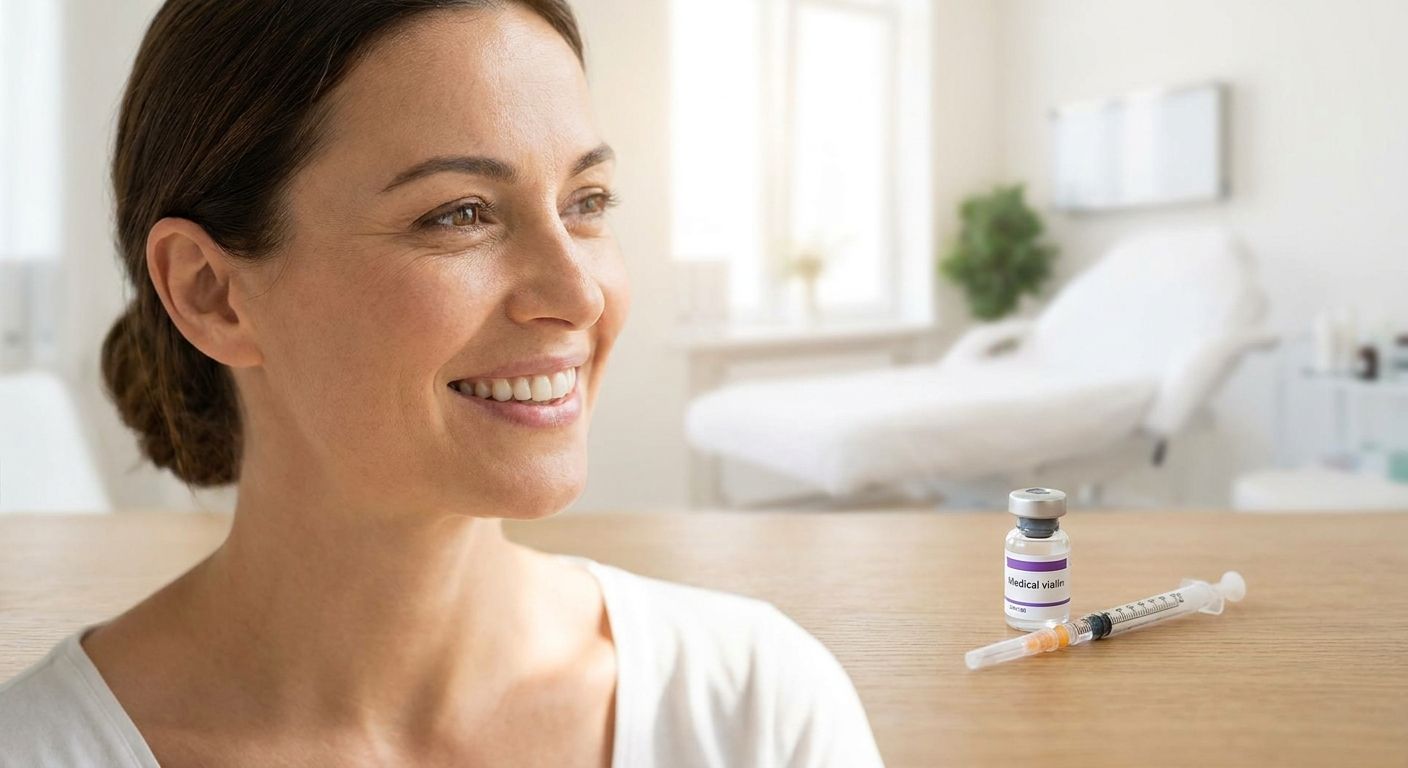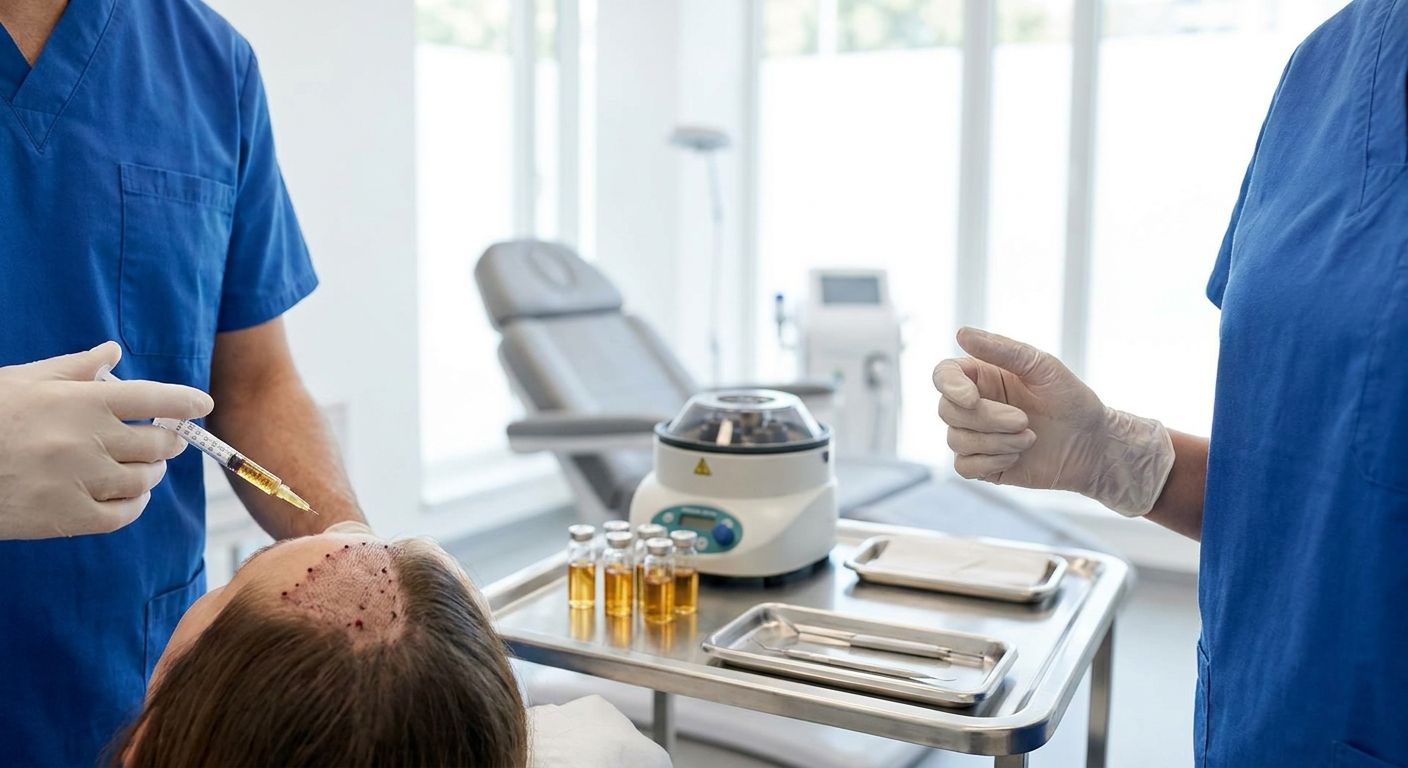
PRP for hair loss works by spinning down your own blood into platelet-rich plasma and injecting the growth-factor concentrate into thinning areas of the scalp — but the protocol behind that injection determines whether you see regrowth by month four or spend money on a treatment that stalls after session one. In 2026, PRP hair restoration is one of the fastest-growing non-surgical categories in medical aesthetics, and the difference between a strong result and a wasted appointment usually comes down to whether the provider matched the protocol to the actual cause of your shedding.
- The best PRP treatment for hair loss in 2026 depends on what's driving the shedding — hormonal, postpartum, or genetic — not the injector's marketing.
- PRP hair restoration for postpartum hair loss targets the six-to-twelve month shedding window new moms hit hardest — Buy, timed correctly.
- PRP hair restoration for women addresses diffuse, hormone-driven thinning specifically — Buy for ages 25 to 55.
- PRP hair restoration for men focuses on crown and temple regrowth in early androgenetic alopecia — Buy.
- A single PRP session without a full three-treatment series rarely shows visible regrowth — Skip if that's all that's offered.
Why this matters
Hair shedding has more than one cause, and PRP only works when the protocol matches that cause. A new mother losing hair in clumps at month eight postpartum needs a different session cadence than a 45-year-old man with a receding hairline he's watched for a decade. PRP hair restoration for postpartum hair loss exists as its own protocol at Luxus Aesthetics precisely because hormonal shedding after childbirth resolves on a different timeline than genetic thinning.
Most clinics selling PRP in 2026 sell one package regardless of why you're losing hair. That's the gap this guide is built to close: not whether PRP works — published dermatology literature on androgenetic alopecia already supports it — but which protocol actually fits your situation.
How we ranked
Every entry below is scored on four factors: whether the protocol screens for the actual cause of hair loss before treatment starts, whether the session count and spacing match what published PRP research supports (a series, not a one-off), whether maintenance is built into the plan, and whether the provider adds complementary modalities only when they genuinely improve absorption rather than as an upsell. A protocol that skips screening or sells a single session as a complete treatment loses points fast, because dosing frequency is the single biggest driver of visible regrowth in PRP hair restoration.
The ranked list
1. PRP hair restoration for postpartum hair loss — the six-month shedding fix
Postpartum shedding typically peaks between six and twelve months after delivery, when estrogen drops back to baseline and hair that stayed in its growth phase during pregnancy suddenly sheds at once. PRP hair restoration for postpartum hair loss times the injection series to that window instead of treating it as generic thinning. Three sessions spaced four to six weeks apart give the scalp enough growth-factor exposure to re-anchor follicles before the shedding phase ends on its own. Verdict: Buy for new moms six months or later postpartum with diffuse thinning.
2. PRP hair restoration for women — the hormonal-thinning specialist
Women's hair loss is rarely a single-cause problem — thyroid shifts, perimenopause, and androgenetic patterns all present as diffuse thinning rather than the receding hairline pattern seen in men. PRP hair restoration for women builds in a screening step for that reason before the first injection. The standard series runs three sessions with maintenance every four to six months once regrowth stabilizes. Verdict: Buy for ages 25 to 55 dealing with overall density loss rather than a single bald patch.
3. PRP hair restoration for men — the crown-and-temple pick
Male pattern hair loss follows a predictable map: temples first, crown second, and PRP works best when it's caught in that early-to-moderate stage rather than after the follicle has gone dormant for years. PRP hair restoration for men follows the same three-session, four-to-six-month maintenance structure, injected directly into the affected zones rather than the whole scalp. Verdict: Buy for early-stage androgenetic alopecia — this is not a fix for a scalp that's been smooth for a decade.
4. PRP plus microneedling — the enhancer, not the fix
Microneedling before a PRP session opens micro-channels in the scalp that can improve absorption of growth factors, and some providers pair the two for that reason. It adds a step and a cost line without changing the underlying dosing math — you still need the full session series to see results. Verdict: Hold. Worth adding once your core protocol is already working, not a substitute for it.
5. Single-session PRP — the one-and-done trap
A single PRP injection delivers one dose of growth factors to follicles that need repeated exposure over weeks to shift into an active growth phase. Clinics that sell PRP as a one-time treatment are selling a session, not a protocol. Verdict: Skip. If a provider won't commit to at least three sessions upfront, the treatment isn't designed to work.
6. Generic one-size PRP hair package — the assembly-line pick
Some high-volume providers sell the identical PRP hair package to every patient regardless of whether the shedding is postpartum, hormonal, genetic, or stress-related, with no diagnostic screening beforehand. Without matching cause to protocol, you're paying for a treatment that may target the wrong mechanism entirely. Verdict: Skip. A provider who doesn't ask what's causing your hair loss before booking you isn't running a real protocol.
Comparison table
| Approach | Best candidate | Typical session count | Verdict |
|---|---|---|---|
| Postpartum PRP | New moms, 6-12 months postpartum | 3 sessions, 4-6 weeks apart | Buy |
| PRP for women | Hormonal/diffuse thinning, ages 25-55 | 3 sessions + maintenance q4-6mo | Buy |
| PRP for men | Early androgenetic alopecia, crown/temple | 3 sessions + maintenance q4-6mo | Buy |
| PRP + microneedling | Adding absorption to an existing protocol | 3-4 sessions | Hold |
| Single-session PRP | No one — insufficient dosing | 1 session | Skip |
| Generic one-size package | Not screened for cause | Varies, no follow-up | Skip |
Where to buy
- Confirm screening happens before treatment. A provider should ask about timing (postpartum vs. long-standing), pattern (diffuse vs. localized), and any hormonal or thyroid history before recommending a protocol.
- Ask how the platelets are concentrated. A proper PRP draw uses a centrifuge kit with a documented concentration process, not a generic blood draw labeled as PRP.
- Get the full series price and schedule in writing. Three sessions minimum, then maintenance every four to six months — compare that total against any single-session price you're quoted elsewhere.
Find your PRP protocol
Get a hair restoration consult before committing to any package.
FAQ
What's the best PRP treatment for hair loss in 2026?
The best PRP treatment for hair loss in 2026 is the protocol matched to your specific cause of shedding — postpartum, hormonal, or genetic — not a generic one-size package. A three-session series with four-to-six-month maintenance is the standard structure across all three candidate types.
How many PRP sessions do I need to see hair regrowth?
Most PRP hair restoration protocols require three sessions spaced four to six weeks apart before regrowth becomes visible. A single session rarely produces noticeable results because follicles need repeated growth-factor exposure to shift into an active growth phase.
Is PRP better than minoxidil for hair loss?
PRP and minoxidil work through different mechanisms and are often used together rather than as competitors. PRP delivers concentrated growth factors directly to the follicle via injection, while minoxidil is a topical applied daily long-term.
Does PRP hair restoration hurt?
PRP scalp injections cause mild discomfort, typically described as a series of quick pinpricks across the treated area. Numbing is commonly used before injection to reduce sensation during the session.
How much does PRP treatment for hair loss cost?
PRP treatment for hair loss cost varies by clinic and by how many sessions your protocol calls for. Ask for the full three-session price upfront rather than comparing a single-session number, since a one-off session isn't a complete treatment.
Can men and women use the same PRP protocol?
Men and women typically need different PRP protocols because their hair loss patterns differ — men usually show localized crown and temple thinning, while women present with diffuse density loss. Injection zones and screening steps are adjusted accordingly.
How soon after having a baby can I start PRP for postpartum hair loss?
Most postpartum PRP protocols begin once shedding has clearly started, typically around the six-month mark, rather than immediately after delivery. Starting too early can mean treating hair that would have stabilized on its own.
Does PRP work with microneedling for hair loss?
PRP paired with microneedling can improve growth-factor absorption into the scalp, but it's an enhancement rather than a replacement for the core session series. The underlying three-session protocol still drives the result.
One last thing
The clinics that skip the diagnostic step — checking what's actually causing the shedding before the first PRP injection — are the ones whose patients call back at month six asking why nothing changed. Ask about that screening before you ask about the price; it's the single biggest predictor of whether your PRP protocol in 2026 actually works.