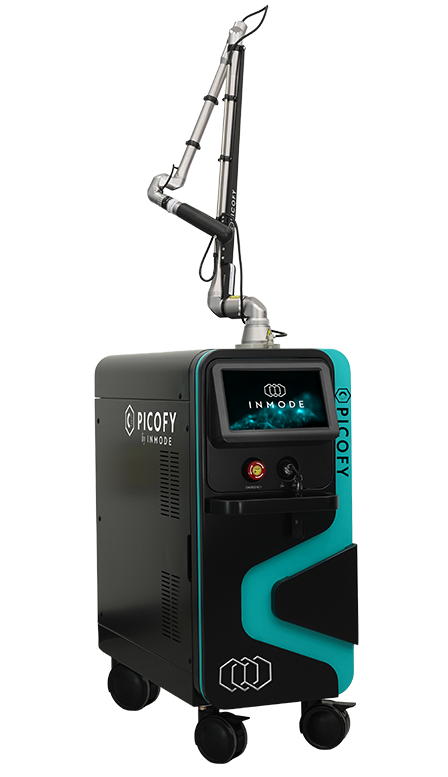
PicoFy™ by InMode is an advanced picosecond Nd:YAG laser platform that combines two wavelengths with three handpieces for unwanted tattoos, benign pigmented lesions, acne scars, wrinkles, and uneven texture. For a personalized plan at Luxus Aesthetics in Colorado Springs, book a Colorado consultation.
- PicoFy laser treatments use 1064 nm and 532 nm wavelengths for different pigment depths and colors.
- Zoom targets individual pigment and tattoo areas with adjustable 2–10 mm spot sizes.
- Array MLA 110 creates about 170 microbeams for fractional pigment and texture treatment.
- Peak MLA 60 creates about 300 smaller microbeams for denser fractional skin renewal.
- Luxus Aesthetics offers PicoFy consultations through its Colorado Springs booking page.
Why PicoFy matters in 2026
PicoFy lets the provider change the wavelength, spot size, and energy-delivery pattern according to the concern. A single brown spot does not need the same approach as diffuse texture, an acne scar, or tattoo ink below the skin.
The platform delivers energy in pulses measured at 300 picoseconds, or 300 trillionths of a second. InMode’s 2026 specifications list peak power up to 2.0 gigawatts and a uniform top-hat beam profile. The short pulse is designed to create a photoacoustic effect that breaks targeted pigment into smaller particles while limiting prolonged heat exposure around it.
PicoFy is a customizable laser platform, not one fixed treatment. Results depend on the target, wavelength, handpiece, settings, and your skin’s response.
What is PicoFy, and what does it treat?
PicoFy is a picosecond Nd:YAG laser. InMode lists tattoo removal, pigment concerns, and non-invasive face, neck, and body treatment among its 2026 treatment categories. Patient information also identifies acne scars and wrinkles.
Its main treatment roles are:
- Unwanted tattoo ink: focused energy breaks pigment into smaller fragments that the body can gradually clear.
- Benign pigmented lesions: selected areas of excess pigment can be treated after the provider confirms they are appropriate for laser treatment.
- Uneven tone: fractional treatment can cover areas where discoloration and texture overlap.
- Acne scars: microscopic treatment zones support a remodeling response within the skin.
- Wrinkles and texture: fractional energy provides non-invasive renewal rather than direct pigment removal alone.
- Face, neck, and body areas: several spot sizes adapt coverage to the treatment zone.
PicoFy does not diagnose a changing mole, unexplained lesion, active skin disease, or suspicious pigmentation. Those concerns need medical evaluation before cosmetic laser treatment.
PicoFy modalities at a glance
Here, modality means the wavelength and handpiece combination used to deliver treatment.
| PicoFy modality | Technical range | Main role | Key distinction |
|---|---|---|---|
| 1064 nm wavelength | All three handpieces | Deeper or darker pigment, including dark tattoo ink | Penetrates more deeply than 532 nm |
| 532 nm wavelength | All three handpieces | Superficial pigment and selected warm-colored tattoo inks | Absorbed more strongly near the surface |
| Zoom | 2–10 mm spots | Focused tattoo and pigment treatment | Direct, adjustable full-beam delivery |
| Array MLA 110 | 4–12 mm; about 170 microbeams at 110 µm | Fractional pigment, tone, and texture | Broader microscopic pattern |
| Peak MLA 60 | 4–12 mm; about 300 microbeams at 60 µm | Denser fractional texture and scar treatment | More, smaller microbeams |
A PicoFy plan pairs a wavelength with a handpiece, then adjusts spot size, energy, and coverage for the target.
The 1064 nm modality: deeper and darker targets
The 1064 nm Nd:YAG wavelength travels more deeply and is commonly used for darker pigment. In tattoo treatment, it is the usual starting wavelength for black and other dark inks.
With Zoom, 1064 nm energy can target a defined tattoo or pigmented area. With Array MLA 110 or Peak MLA 60, the wavelength is divided into microscopic beams for fractional treatment across a wider area.
Tattoo ink can be layered, mixed, or changed by earlier treatments, while natural pigmentation can sit at different depths. Skin tone and the risk of temporary lightening or darkening also influence the plan.
The 532 nm modality: more superficial pigment targets
The 532 nm wavelength is absorbed more strongly by targets near the surface. It is often selected for appropriate superficial brown pigment and tattoo colors such as red or orange when the ink responds to it.
Careful patient selection matters because 532 nm interacts readily with surface pigment. Visible color does not always reveal tattoo ink chemistry, and not every brown mark should be treated with a cosmetic laser.
Having both wavelengths gives PicoFy more flexibility than a one-wavelength system. It does not mean every lesion or ink color responds equally.
Zoom: focused pigment and tattoo treatment
The PicoFy Zoom handpiece uses 1064 nm and 532 nm wavelengths with adjustable spot sizes from 2 to 10 millimeters. Smaller spots support precise treatment of limited areas; larger spots cover broader targets when the treatment plan allows.
Zoom delivers a full beam rather than dividing it into a fractional array. It is the direct-treatment modality for:
- Unwanted tattoo pigment
- Discrete benign pigmented lesions after assessment
- Appropriate individual sun-related spots
- Defined areas of excess pigment
A tattoo plan may change wavelengths between sessions because ink colors absorb energy differently. Dense professional tattoos, cover-ups, cosmetic pigments, and previously treated ink all need individual assessment.
Array MLA 110: broader fractional renewal
MLA means micro-lens array. The handpiece divides the beam into microscopic points, leaving intervening tissue largely untreated rather than covering the entire area with one continuous beam.
InMode’s 2026 specifications state that Array MLA 110 creates about 170 microbeams, each approximately 110 micrometers wide. It supports both wavelengths and spot sizes from 4 to 12 millimeters.
Array MLA 110 can be selected for:
- Uneven tone across an area
- Skin texture refinement
- Pigment correction combined with renewal
- Wrinkles
- Acne scars where fractional coverage fits
At each focal point, the energy creates laser-induced optical breakdown, or LIOB. In plain terms, it produces controlled microscopic treatment zones while preserving surrounding tissue between those points.
Peak MLA 60: denser fractional precision
Peak MLA 60 creates more and smaller microbeams. InMode’s 2026 specifications describe about 300 microbeams at approximately 60 micrometers each, with both wavelengths and 4 to 12 millimeter spot sizes.
The denser pattern gives the provider another way to distribute energy for:
- Acne-scar texture
- Fine textural irregularities
- Wrinkles
- Broader skin renewal
- Selected body areas
Peak MLA 60 is not automatically stronger or better than Array MLA 110. The patterns are different, and the provider selects one according to skin characteristics, area, and intended treatment intensity.
How the six core combinations work
Two wavelengths across three handpieces create six core combinations:
- 1064 nm with Zoom: focused dark tattoo ink or appropriate deeper pigment.
- 532 nm with Zoom: focused superficial pigment or responsive warm-colored ink.
- 1064 nm with Array MLA 110: broader fractional treatment with larger microbeams.
- 532 nm with Array MLA 110: superficial fractional pigment-and-texture treatment.
- 1064 nm with Peak MLA 60: denser fractional treatment with smaller microbeams.
- 532 nm with Peak MLA 60: dense superficial fractional treatment when the target and skin assessment support it.
These are treatment building blocks, not six prepackaged services. The provider combines them to fit the concern.
What happens during a PicoFy consultation?
A Colorado Springs consultation should start with the concern, not the machine. Share any prior laser sessions, tanning or sun exposure, medications, pigment changes, and history of unusual scarring.
For a tattoo, the provider reviews:
- Ink colors and density
- Professional, amateur, cosmetic, or traumatic origin
- Layers or cover-up work
- Body location
- Previous removal attempts
- Skin tone and pigment response
For skin renewal, the provider assesses whether the main concern is pigment, redness, texture, scarring, wrinkles, or a combination. PicoFy focuses on pigment and fractional renewal; another technology may fit better when redness, laxity, or deeper resurfacing is the primary issue.
Treatment count and spacing are individualized. Ink chemistry, pigment depth, scar structure, intensity, healing response, and treatment area all affect the plan. A responsible consultation does not promise complete clearance or a fixed outcome before examining the skin.
PicoFy versus IPL, microneedling, and resurfacing
PicoFy is not interchangeable with every skin treatment.
| Treatment | Main mechanism | Best matched to | Main limitation |
|---|---|---|---|
| PicoFy | Focused or fractional picosecond energy | Tattoos, benign pigment, acne scars, wrinkles, texture | Response varies by target and skin |
| IPL | Broad-spectrum light | Appropriate red and brown discoloration across a wider area | Not a tattoo-removal treatment |
| Microneedling | Controlled mechanical channels | Texture and acne-scar remodeling | Does not selectively break tattoo ink |
| RF microneedling | Needling plus radiofrequency heat | Texture and tissue remodeling | Different mechanism from a picosecond laser |
| Fractional CO2 | Ablative fractional resurfacing | More intensive resurfacing goals | Different aftercare and downtime profile |
The best treatment is the one matched to the actual problem. When pigment and texture overlap, a provider may recommend staged treatments rather than expecting one device to address every concern.
Preparing for treatment and protecting the result
Preparation changes with the wavelength, handpiece, area, and intensity. Common topics include avoiding an active tan, disclosing products or medications that affect light sensitivity, and reporting active irritation or infection in the treatment area.
After treatment, follow the clinic’s cleansing, moisturizing, sun-protection, and product-restart instructions. Do not pick at flaking or crusting. Contact the office about a reaction outside the expected guidance you received.
Colorado’s elevation makes daily sun protection especially relevant when treating unwanted pigment. Repeated ultraviolet exposure can work against a more even-looking result.
Who should start with a consultation?
Start with a consultation if you are considering PicoFy for a tattoo, brown spot, acne scars, wrinkles, or uneven texture. Assessment is especially important when pigmentation is new, changing, raised, irregular, previously diagnosed, or treated before.
Luxus Aesthetics provides personalized cosmetic and anti-aging care in Colorado Springs. To discuss whether Zoom, Array MLA 110, Peak MLA 60, or another treatment is appropriate, book with the Colorado office.
FAQ
What is PicoFy by InMode?
PicoFy is a picosecond Nd:YAG laser platform for unwanted tattoos, benign pigmented lesions, acne scars, wrinkles, and non-invasive skin renewal. It combines 1064 nm and 532 nm wavelengths with three handpieces.
What are the three PicoFy handpieces?
The three standard PicoFy handpieces are Zoom, Array MLA 110, and Peak MLA 60. Zoom delivers focused energy, while the two MLA handpieces divide energy into fractional microbeams.
What is the difference between 1064 nm and 532 nm PicoFy treatments?
The 1064 nm wavelength reaches more deeply and is commonly used for dark pigment, while 532 nm targets more superficial pigment and selected warm-colored tattoo inks. The provider chooses after examining the target and skin.
What does the PicoFy Zoom handpiece do?
PicoFy Zoom delivers focused 1064 nm or 532 nm energy through adjustable 2–10 mm spot sizes. It is designed for targeted tattoo and benign-pigment treatment.
How is Array MLA 110 different from Peak MLA 60?
Array MLA 110 creates about 170 microbeams at 110 µm, while Peak MLA 60 creates about 300 smaller microbeams at 60 µm. The patterns let the provider adjust fractional coverage for pigment, scars, wrinkles, and texture.
Can PicoFy remove every tattoo color?
No laser is equally effective for every ink. Response depends on pigment chemistry, color, depth, density, layering, skin characteristics, and the wavelengths available.
Is PicoFy only for the face?
No. InMode lists non-invasive face, neck, and body treatments among PicoFy’s treatment categories, along with tattoo and pigment removal. The provider determines whether a specific area is appropriate.
Where can I book PicoFy in Colorado Springs?
Book a consultation through the Luxus Aesthetics Colorado Springs scheduling page. The office can assess your concern and recommend the appropriate PicoFy modality or another treatment.
One last thing
The most important PicoFy setting is not the highest energy or densest handpiece. It is the combination that matches the target while respecting your skin’s pigment response. In 2026, the platform’s advantage is the choice between two wavelengths, three delivery patterns, and multiple spot sizes.