PRP hair restoration for men pulls growth factors from your own blood to wake up shrinking follicles — but it only works if the follicle is still alive, and knowing your Norwood stage before you book saves months of wasted appointments.
- PRP hair restoration for men works on Norwood I-III thinning, not full baldness — Skip past Norwood VI.
- Pairing PRP with microneedling drives growth factors into the follicle bulb instead of the scalp surface. Consider the combo.
- A real course runs several monthly sessions before results are judged, then periodic maintenance — inconsistent visits waste the platelets.
- Luxus Aesthetics screens Norwood stage before recommending PRP hair restoration for men, from Happy Valley, Oregon to Colorado Springs, Colorado.
Why This Matters
By age 50, close to 85% of men show noticeable hair thinning, and roughly a quarter already see the first signs by their late 20s, per the American Hair Loss Association. PRP — platelet-rich plasma — concentrates the growth factors already circulating in your blood and injects them where a follicle is miniaturizing but not dead. It extends the anagen, or growth, phase. It doesn't regrow hair that's already gone.
Luxus Aesthetics, a boutique medical spa with locations in Happy Valley, Oregon and Colorado Springs, Colorado, treats PRP as one piece of a broader regenerative approach, not a stand-alone miracle. That distinction is the whole game in 2026: the men who see real density gains are the ones screened honestly before a needle ever comes out.
Who PRP Hair Restoration Is For
PRP hair restoration for men fits a specific window: Norwood I through III, where the hairline has receded or the crown has thinned but the follicle hasn't fully closed. It suits men who want to slow visible loss before committing to a transplant, and men already on minoxidil or finasteride who want a needle-based boost rather than another pill. Men booking that conversation often ask about broader facial maintenance in the same visit — dermal fillers for men sits in the same quiet-upgrade category as PRP for hair, and boutique spas that offer one usually offer both.
What to Look For in PRP Hair Restoration for Men
Medical oversight, not a tech with a kit
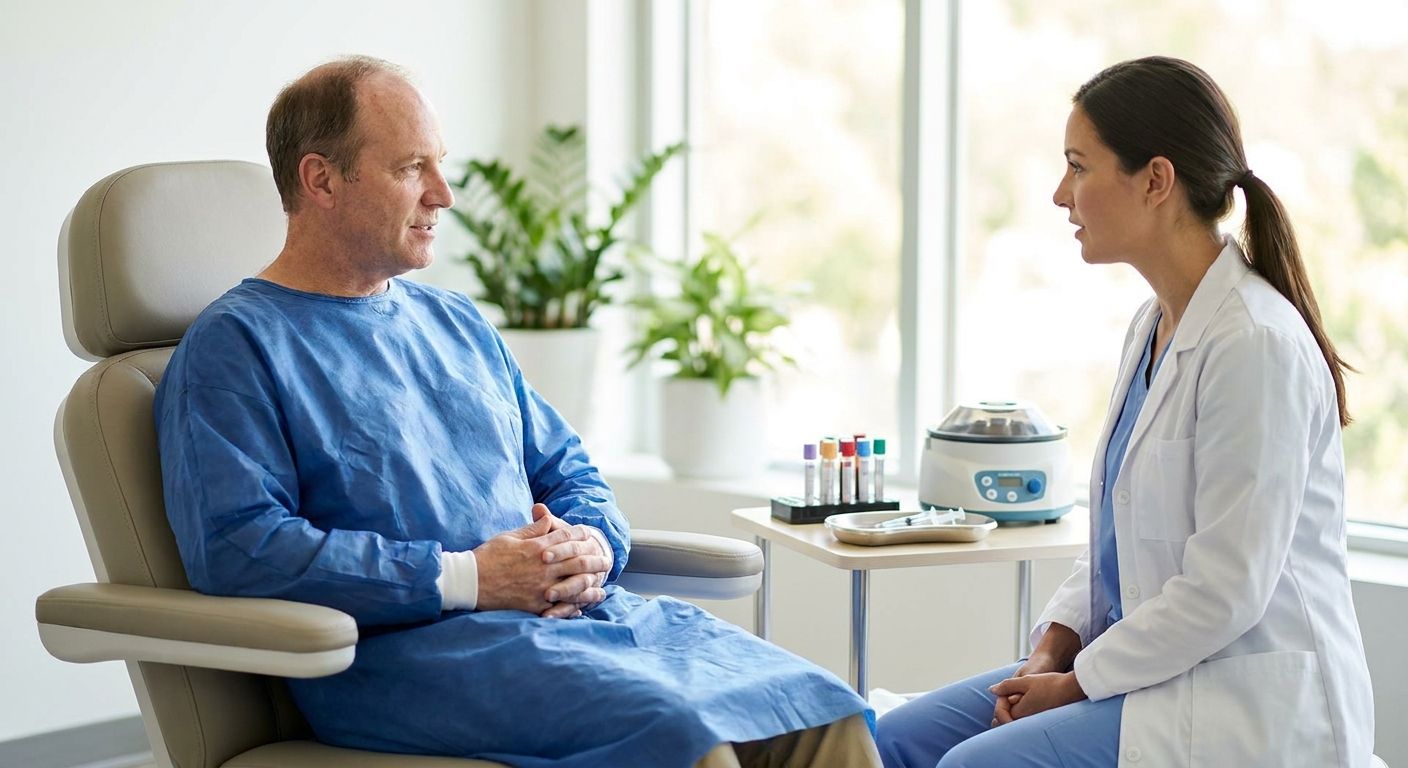
PRP involves a blood draw, centrifuge processing, and scalp injections — this is a medical procedure, not a spa add-on run by whoever's free that hour. Ask who draws the blood and who administers the injections; if the answer is vague, that's your answer.
Double-spin centrifuge processing
Platelet concentration varies wildly depending on how the blood is spun. A single-spin process leaves more red and white cells in the mix, diluting the platelet yield that actually does the work. Providers running a proper double-spin protocol will say so without being asked twice.
A protocol that pairs PRP with microneedling
Growth factors do more when they're driven into the dermis instead of sitting on the scalp surface. Microneedling opens micro-channels that let PRP reach the follicle bulb rather than pooling at skin level — ask specifically whether that step is included or billed separately.
Honest candidacy screening, not a sales pitch
A provider who books you for PRP without checking your Norwood stage, family history, or how long you've been shedding is optimizing for revenue, not results. Real screening includes photos and a stated rationale for why PRP fits your specific pattern.
A defined course, not a single session
One PRP session does close to nothing measurable. Published dermatology protocols commonly structure an initial course as three to four sessions spaced four to six weeks apart, followed by maintenance every four to six months. A provider quoting a single visit as a fix is setting you up to be disappointed.
Top Picks: Which PRP Path Fits Your Hair Loss Stage
The early-thinning candidate — Norwood I-II. This is the strongest response window: follicles are miniaturizing, not dead, and the scalp still shows a mix of terminal and vellus hair. Response rates in this group tend to be the most visible of any candidate profile. Verdict: Buy.
The combo stacker — PRP plus microneedling, layered on minoxidil or finasteride. If you're already medicating and want a needle-based addition rather than a new pill, this is the pairing to ask for by name. Some boutique spas run the same growth-factor equipment across services — a place offering PDGF under eye treatment for dark circles and hollows is typically set up for platelet-based scalp work too, since both draw from the same regenerative category. Verdict: Buy.
The post-transplant booster. Men who've had a hair transplant sometimes add PRP in the months after surgery to support graft survival and surrounding native hair. This is a supporting role, not a replacement for the surgical result itself. Verdict: Consider.
The advanced-baldness seeker — Norwood VI-VII. If the scalp has gone smooth and shiny with no terminal hair left, there's no follicle left for PRP to stimulate. No amount of centrifuge spinning changes that biology. Verdict: Skip.
Ready to check your candidacy?
Talk through your Norwood stage and treatment options before you book anything.
What to Avoid
- At-home PRP kits. Without a medical-grade centrifuge and sterile injection technique, you're injecting improperly processed plasma into your own scalp — skip anything sold as a DIY kit.
- "One and done" marketing. A single session isn't a course. Any provider promising visible density from one visit in 2026 is setting an expectation the biology can't support.
- No staging conversation. If nobody asks about your Norwood level, family hair-loss history, or timeline of shedding before quoting you a price, that's a red flag, not a fast pass.
Verdict Comparison
| Candidate Profile | Norwood Stage | Recommended Protocol | Verdict |
|---|---|---|---|
| Early-thinning candidate | I-II | PRP monotherapy, 3-4 sessions | Buy |
| Combo stacker | II-III | PRP + microneedling, layered on medication | Buy |
| Post-transplant booster | Post-surgical | PRP as adjunct, timed with recovery | Consider |
| Advanced-baldness seeker | VI-VII | None — no viable follicle target | Skip |
“PRP works on hair that's thinning, not hair that's gone.”
FAQ
What is PRP hair restoration for men?
PRP hair restoration for men uses platelets concentrated from your own blood, injected into the scalp to extend the growth phase of miniaturizing follicles. It works best on Norwood I-III thinning, not fully bald areas.
Is PRP hair restoration painful?
Most men describe scalp injections as a series of quick pinches rather than sharp pain, especially with topical numbing beforehand. Discomfort is usually rated mild to moderate and passes within the same visit.
How many PRP sessions do men need for hair loss?
An initial course commonly runs three to four sessions spaced four to six weeks apart, followed by maintenance every four to six months. Fewer sessions rarely produce measurable results.
Is PRP better than finasteride or minoxidil for men?
PRP is not a replacement for finasteride or minoxidil — it's typically layered on top of them for a stronger combined response. Men on medication who add PRP tend to see more visible improvement than either approach alone.
Can PRP regrow hair on a fully bald scalp?
No. PRP stimulates follicles that are still alive but shrinking; it cannot revive a follicle that has fully closed. Men at Norwood VI-VII are not good candidates.
How long do PRP hair restoration results last?
Results depend on maintenance frequency, with most protocols calling for touch-up sessions every four to six months to sustain gains. Stopping maintenance typically allows thinning to resume its prior pace.
Is PRP hair restoration safe for men in their 20s?
Yes, PRP is commonly used on men in their 20s and 30s who catch thinning early, since earlier intervention on a still-viable follicle tends to respond better. A candidacy screening still applies regardless of age.
How much does PRP hair restoration cost in 2026?
Cost varies by provider, region, and number of sessions in a course, so check current pricing directly with the med spa you're considering. Multi-session packages are typically priced lower per visit than single one-off sessions.
One Last Thing
The detail most men skip past: PRP doesn't fail because the platelets are weak, it fails because the follicle was already gone before the needle touched the scalp. Dermatologic literature is consistent on this point — a closed follicle has no receptor left to respond to growth factors, no matter how well the plasma was processed. Get staged honestly before you commit to a course, not after three sessions show nothing.